
Horse Training
Jumping
From: Horse Training
See also: Jumps • Show Jumps • Cross Country Jumps
Show Jumping • Pole Work
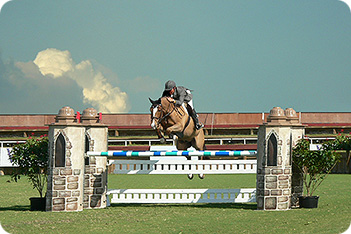
Horse Training - Jumping
Once your horse is working in balance and rhythm over poles on the flat in walk, trot and canter then you are ready to begin jumping.
Have your horse trot through a line of at least five trot poles at first, at a distance that suits him. Then position your jump wings either side of the last trot pole and taking the last two trotting poles make a small cross pole. Then come through the line of trotting poles to the cross pole keeping yourself looking straight ahead with your lower leg encouraging the horse on, when you feel the horse start to raise its forehand to jump then start to fold into the jumping position over the jump allowing your hands to move forward to allow the horse to stretch over the jump, on landing regain your upright position and rein contact and ride the horse away from the fence in a controlled manor.
To begin with you want your horse to gain in confidence with the approach, takeoff, jump and landing, by keeping the fences small to start off with you allow the horse the ability to get themselves out of any trouble they get themselves into without them losing their confidence.
When your horse is working in trot over a single fence quite happily then you can proceed in canter, change the trot poles to canter pole striding, this will help to keep the horse in a balanced rhythm all the way up to the fence.
When your horse is working in canter over the fence and is able to maintain rhythm and balance before and after the fence then you can move on to ride some single fences around the arena, at first it will help the young inexperienced horse to remain in balance if you position a placing pole before each fence. Position each fence in a separate location around the arena to allow you to enough time to regain the horses balance and rhythm in between fences. Gradually over time remove the placing poles.
Types Of Fence
- Cross Pole
This is when two poles are positioned with one end of each pole resting on a jump wing so that the poles form a cross in the center. They are used as a warm up fence and also encourage the horse to jump in the center of the fence. - Upright Fence
This is a pole that goes straight across and is at the same height on both of the jump wings. Upright fences should always have second pole that either hangs under the upright pole or is lying on the floor directly under the jump. This helps the horse to gauge the height of the fence and makes it more inviting to jump. - Spread Fence
This is a single fence that uses two pairs of jump wings so that the fence can be increased in both height and width. A spread fence can be either an 'Ascending' spread which is one that increases in height with the back of the fence higher than the front, or a spread can be a square parallel which is when both the front and back rail are at the same height. Spread fences are designed to encourage the horse to stretch out over the fence and bascule, a spread fence should always have filling poles added so that it does not look too airy. - Bounce Fence
This is two separate fences positioned quite close together so that when the horse lands over the first fence it then has to immediately take off over the second fence. - Double
This is two separate fences positioned with either a one or two non jumping strides in between them, The term "one stride double" refers to the fact that you can fit one non jumping canter stride in between each fence. And the same goes for the term of "two stride double" whereby two canter strides can be fitted in between the fences. - Treble
This is where three separate fences are positioned in a row with either a one or two stride distance added in between. The most commonly found treble in competition is with a one non jumping stride in between the first and second fence and a two non jumping stride between the second and third fence. Trebles can be a mixture of uprights and spreads depending on the course designers preference.
Related Distance
This refers to a distance in between two fences that the course designer has set to be ridden with a certain number of strides in mind, this is where the skill of knowing your horse comes in so that you can judge how best to ride the distance, for example if you have a four stride distance and are riding a short striding horse you may adjust your horses stride so that the distance becomes five strides instead of four.
A related distance can be either on a straight line or on a "dog leg" which is where there a turn or bend has to be made in between the fences.
Grid Work
Now that your horse is confident jumping single fences you can progress to jumping through a grid which is a series of fences in a row designed to be ridden with a set number of strides in between each fence, grids will help the horse to become quick thinking and more agile while jumping and can also be used to improve the horses position over the fence as well as encouraging the horse to lengthen and shorten their stride and cope with distances in between fences.
Start off with trotting poles to a small cross pole, encouraging the horse to land in canter, then canter in over canter poles to the cross pole. You can then add a second fence with a one non jumping stride distance in between which allows for take off and landing.
Start off using cross poles as they will encourage the horse to stay straight throughout the grid. When your horse is working through a one non jumping stride with ease then you can add a third fence again with a one non jumping stride in between allowing for take offs and landing distances. When using cross poles ensure that you have the center part of all the fences lined up in a straight line.
The more confident your horse becomes the more challenging you can make the grid. A bounce fence can be added at the start of the grid, this type of fence will require the horse to land after the first cross pole and then immediately take off over the second fence.
A two stride distance can also be added in between fences as well as changing the height and width of the fences, To begin with raise the very last fence first and when the horse is working through comfortably you can increase the height of the other fences. Remember that as you increase the height you will also need to adjust the distance in between the fences as well.
Grid Work Exercises
- Cross pole with a one non jumping stride to a cross pole.
- Cross pole to cross pole to cross pole with a one non jumping stride in between each.
- Cross pole to cross pole to upright with a one non jumping stride in between each.
- Cross pole to upright to upright with a one non jumping stride in between each.
- Cross pole to upright to spread with a one non jumping stride in between each.
- Upright to upright to spread with a one non jumping stride in between each.
- Upright to spread to spread with a one non jumping stride in between each.
- Upright to spread to upright with a one non jumping stride in between each.
- Cross pole with a bounce distance to a cross pole to an upright with a one non jumping stride in between.
- Upright with a bounce distance to a upright fence to a one stride distance to a upright or spread fence.
- Upright fence with a one non jumping stride to a spread fence with a two non jumping stride distance to spread or single fence.
Walking A Course Of Show Jumps
In competition a course is made up of 8 to 12 show jumps, which will contain a variety of fences such as uprights, spreads a double and in more experienced classes a treble as well.
When you first go into the arena it is a good idea to enter as you would on horse by entering through the warm up entrance, this will give you an idea of where you are in the arena and you will therefore be able to see the best route to your first fence. It is a good idea to see which canter rein you will need to enable you to get an organized and balanced canter ready in plenty of time to start your round.
Once you have located your first fence find the starting markers, once you hear the bell you will need to pass through these markers to begin your round or it will not count and you will be eliminated.
Walk through the start markers and directly up to the middle of the fence at the point where you hope to jump it, then look up over the fence and find your second fence, once you have found your second fence walk around the fence to opposite where you where just stood and again look up for your second fence and walk purposefully towards it again aiming for the middle. You will need to walk up to every fence in this way always in front of you to the next one, this will help you when you come to ride the course to not get lost as when you are on horseback the jumps will come up very quickly in succession.
Always walk turns and corners as you will when you are riding, this will give you time to regain any lost rhythm and balance and set you up for the next fence, it is only when you get to the jump off that you should start thinking of the quickest line between two fences.
If there are any doubles, trebles or related distances then you will need to walk the distance in between the fences. By knowing your horses stride and way of going you will be able to ride through the jumps accurately and give your horse the best possible chance of jumping clear.
When you get to the last fence walk through the finish and in between the markers and then onto the exit. During your course walk you should also be aware of the ground conditions for example if their are any slippery or deep patches or any uneven ground that should be avoided.
Riding A Course Of Show Jumps
Enter the arena and proceed to pick up the correct canter lead, so that when you hear the bell to start you can proceed directly to the first fence passing between the start markers. Aim to ride the course of jumps in the same way that you walked it, so that you make the most use of the arena and give your horse plenty of room to turn and stay in rhythm and balance. Pay particular attention to turns, approaches, take offs, jumping landing, and get aways. During your round keep yourself looking up and ahead the whole time, if you do hear the unfortunate sound of a pole falling to the ground, do not look back as it will unbalance the horse and rider and can be a distraction for your next fence so keep yourself riding forwards positively towards your next fence. When you have completed your round remember to pass through the finish markers and then gradually steady the horse down to walk and leave the arena in a controlled manor not forgetting to praise your horse for a job well done.

Equestrian and Horse • The Equestrian • The Horse 'Equus' • Equestrian News • Horse Tack • Horse Care
Equestrian Clothing • Horse Riding • Horse Worming • Horse Training • Horse Bits • Riding Holidays
Horse Shows • Horse Videos • Riders • Equine Art • Books • Directory • Site Map • Contact Us
© 2012 Equestrian and Horse
