
Horse Competition's
Polo
From: Equestrian and Horse • Horse Competitions
See Also: Horse Breeds • Show Dates
Polo
The sport of Polo has a rich history that dates back to a time even before the Persians and has long since been a popular team sport that is now enjoyed throughout the world with Great Britain, Argentina and the United States of America fielding some of the finest Polo players in the world.
Originates
The sport of Polo originates from Iran or Persia as it was known then back in the 5th century and takes its name from the Tibetan word Pulu which means ball.
How Many Players
There are 4 team members each with a key role to play and recognized by the number they wear. (For arena polo there are 3 players instead of 4).
- Number 1 has two main jobs firstly to score goals and secondly to keep the opposing number 4 player away from the goal.
- Number 2 player helps to keep the ball in play and to try and get goals.
- Number 3 player shoots for goals and also defends the goal from the opposing team, they must be able to do both very well and it is usually the Number 3 player that is also the captain.
- Number 4 player defends the goal from the opposing team.
Handicap
Each player is given a handicap which can vary from -2 goal to + 10 goal. This handicap will mean that they are either High Goal, Medium Goal, Intermediate Goal or Low Goal.
The Game
The object of a game of polo is to score goals through the goal posts by hitting the ball with the mallet. A field polo match is split up into either 4, 6, or 8 periods which are known as chukkas, each chukka lasting for 7 minutes.
In Arena polo there are 4 Chukkas each lasting for 7.5 minutes each.
The Pitch
Polo is traditionally played outside with the size of the pitch varying, an outdoor pitch is usually 300 by 160 yards, with the game being played on grass or snow. Indoor polo is called arena polo and the pitch is slightly smaller at 100 yards by 50 yards.
The goalposts are positioned 8 yards apart one at either end of the pitch.
Polo Scoring
Each team player has a mallet which they should be able to use on both their nearside and their offside as well as both forehand and backhand. By hitting the ball with your mallet into the goal you will score.
The mallet is made of bamboo and is approximately 50 inches long with a wooden head on the end which is used to hit the ball with.
The ball is approximately 3.25 inches wide for outdoor polo and slightly larger for indoor polo being around 12 to 14 inches wide.
Rider Clothing
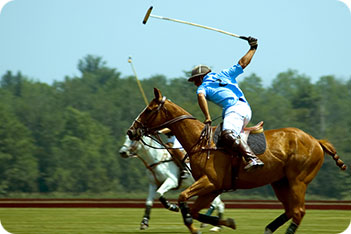
A hard hat which will often have a face guard at the front, knee guards, long leather boots, jodhpurs or breaches, spurs, mallet and gloves all form part of the basic dress for polo with each team player also wearing a polo shirt which has their number upon it.
Polo mallets were traditionally made of bamboo but nowadays they are made of manau with the upper handle part wrapped in rubber grip material to aid the riders grip, with mallets often around 50 to 54 inches with varying amounts of whippiness or flexibility which comes down to rider preference. The cigar shaped durable wooden mallet head is often made of Ash or Maple and is around 8.5 to 9.5 inches in length.
Polo Horses
Polo ponies as they are often referred average 14.2 to 15.3 HH and are well trained and athletic in the maneuvers necessary for the sport being able to achieve sharp turns, abrupt halts, and accelerated transitions both upwards and downwards at any given moment and it is for this reason that each rider often has a string of horses available per match with riders in the higher levels of the sport often having as many as one horse available per individual chukka, due to the intensity of the match.
Horses are trained to neck rein so that the rider only has to use one hand for the reins leaving their other hand free for using the mallet, the horse also have their lower legs heavily bandaged to protect against both the strain of competition and for knocks.
Horses usually wear a bridle with a pelham or gag bit so that two sets of reins can be used for greater accuracy. Other tack often includes a standing martingale, breastplate and a close contact polo saddle which often do not have a knee roll, an over girth is always a good idea to help secure the saddle and saddle cloth is often but not always used. The horses tail is wrapped up to prevent it from getting caught up in a mallet and manes are often hogged.
Although any breed of horse can potentially be used Thoroughbred, Quarter horse and Criollo horses are the most common especially crosses of these breeds.

Equestrian and Horse • The Equestrian • The Horse 'Equus' • Equestrian News • Horse Tack • Horse Care
Equestrian Clothing • Horse Riding • Horse Worming • Horse Training • Horse Bits • Riding Holidays
Horse Shows • Horse Videos • Riders • Equine Art • Books • Directory • Site Map • Contact Us
© 2012 Equestrian and Horse
