
Equestrian History
From: Equestrian and Horse
See also: Rider Aids • Horseback Riding • Equestrian Clothing
Equestrian History
Evidence shows that horses were originally used as a food source long before their strength and speed was harnessed for riding and driving purposes. Although it is uncertain exactly when horses were first domesticated and ridden it is known that they were used for hunting purposes, to pull chariots, transport supplies, go into countless battles and for farming.
With improvements being made to the training of horses and to the riding tack used, horse riding became a more safe and comfortable proposition, allowing the horse to be used for a number of purposes such as a scout and delivery of the post.
Today the horse riding skills learnt over the years are practiced, developed and taught all over the world. Horses are now not only bred and trained for competition but also used for work and as pleasure horses where they are used for a number of activities both ridden an driven .
To date, certain findings, and certain approximate dates have come to light:
5000BC
- It was in the Eneolithic era around 5000 to 4200 BC that the remains of horses were uncovered along with the remains of cattle and sheep.
- Horses were used for sacrifice and also as a food source and were uncovered in the Volga river region of the Eurasian steppes.
4200BC
- Around 4200 BC, again in the steppes, head maces were found showing further horse domestication.
3500BC
- 3500 BC the Botai culture in northern Kazakhstan were thought to be riding horses as a means to hunt and also using horses as a source of food.
2000BC
- In 2000 BC the Andronova culture (also called the Sintashta culture) are thought to have invented the spoked wheel and chariot. The Sintashta culture were from the Ural Mountains which form part of boundary between Europe and Asia. It is from a site called Sintashta on the upper Ural River that the spoked wheel and chariot were uncovered.
1400BC
- The training of horses has been a long established process, as early as 1400 BC a horse trainer from Turkey called Kikkuli used conditioning and training techniques such as interval training and the use of lengthy periods of walking, trotting and cantering to prepare the chariot horses for battle.
- There is much evidence that chariots were used throughout the Bronze and Iron ages.
1300BC
- Around 1300 BC the Mycenaean's used chariots to go into battle.
- By 1300 BC the chariots use in battle was at its peak although evidence shows that this tailed off by around 400bc.
- Chariots were most commonly pulled by either two, three or four horses.
- A two horse chariot was called a Biga
- A three horse chariot was called a Triga.
- A four horse chariot was called a Quadriga.
Dates Continued
1200BC
- In China during the Shang Dynasty (also called the Yin Dynasty) around 1200 BC the use of the chariot became more widespread.
680BC
- Chariot racing became popular in Constantinople and around 680 BC was added to the Olympic games and took place in an arena called a hippodrome.
350BC
- Horses were originally trained with aggressive force up until around 350 BC when the teachings of in particular, Xenophon helped to transform the way that horses were treated and trained. Xenophon wrote a book on horsemanship in which he details information on how to select and break a young colt, how to select an older horse, how to care, groom and bridle horses correctly, mounting procedure, riders position and training, advanced training, equipment for battle, riding the spirited and dull horse, creating a showy horse, creating a parade horse and advice on biting. Xenophon's information was used to train horses not only for military purposes but also for general riding.
400 to 1500 AD
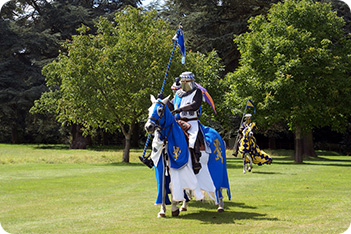
- During the middle ages Knights were mounted when going into battle.
- The use of light cavalry, where a horse and rider are lightly armored, carrying light weapons such as bows and arrows, spears and later on with rifles, were used by many cultures such as the Egyptians, Huns, Turks and Mongols. The horses had to be fast and agile and because neither they or there riders were heavily armored the lightweight horse breeds such as the Arab and Akhal Teke were used.
- Medium weight horses were required by the Iron age to accommodate the increase in weight of the armour and also to enable the horses to pull heavier chariots, supply wagons and armory. Horse breeds such as the Friesian, Andalusian and Lipizzaner were used due to their strength and agility.
1900 to Present Day
- Classical horse riding techniques used today have been most recently influenced by Alois Podhajsky, who was born in 1898 and died in 1973. Podhajsky became chief of the Spanish Riding School of Vienna in 1939 but was also a bronze Olympic medal winner in the field of dressage, a writer and an instructor. Podhajsky wrote books outlining the training of the horse and rider from basic principles through to more advanced techniques.
- Podhajsky is also well known for saving the beautiful stallions of the Spanish riding school from being killed during world war two by using his friendship with General Patten to place the stallions under American protection and for the rescue of several horses that had been seized from the Piber stud by moving them out of harms way to Austria.

Equestrian and Horse • The Equestrian • The Horse 'Equus' • Equestrian News • Horse Tack • Horse Care
Equestrian Clothing • Horse Riding • Horse Worming • Horse Training • Horse Bits • Riding Holidays
Horse Shows • Horse Videos • Riders • Equine Art • Books • Directory • Site Map • Contact Us
© 2012 Equestrian and Horse
